
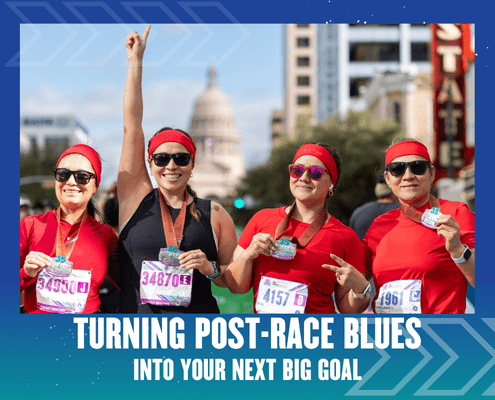
Turning Post-Race Blues Into Your Next Big Goal
After months of training, early alarms, long runs, and race-week excitement, race day finally arrives. You cross the finish line, grab your medal, celebrate with friends and family, and soak in the moment.
And then… the quiet hits.
If you’ve ever felt a surprising emotional dip after a big race, you’re not alone. “Post-race blues” are real, and they can show up as restlessness, irritability, sadness, or a lack of motivation once the adrenaline fades. The good news is this: that feeling does not mean you did anything wrong. It just means you cared deeply about your goal.
Let’s talk about why post-race blues happen and how you can turn that low point into your next big goal.
 Why post-race blues happen
Training for a marathon gives your weeks a clear structure. You have a plan. You have a purpose. You have measurable progress. Your brain gets used to the steady stream of small wins.
After the race, a few things change all at once:
- Your routine disappears. No long run on Saturday, no workout on Tuesday, no countdown to race day.
- Your body is recovering. Physical fatigue and soreness can affect your mood more than you expect.
- Your “big thing” is done. You spent months chasing a finish line, and now it’s behind you.
- The adrenaline drop is real. The high-energy build-up is followed by a sudden emotional comedown.
That crash can feel confusing, especially if your race experience was positive.
 Step 1: Give yourself permission to feel it
First, normalize it. Feeling a little down after a marathon does not mean the race was not worth it. It means you invested your time, identity, and energy into something meaningful.
Try this simple reframe:
The goal ended. Your growth did not.
Instead of pushing the feelings away, give yourself a few days to:
- rest without guilt
- celebrate what you accomplished
- sleep more than usual
- enjoy food, family, and downtime
Recovery is part of endurance. Mentally and physically.
 Step 2: Reflect, do not replay
It’s easy to get stuck replaying the race, especially if things did not go exactly as planned. Reflection is helpful. Replay is exhausting.
A quick, productive reflection exercise:
Write down:
- Three things you did well (even small wins count)
- One thing you learned (fueling, pacing, mindset, training consistency)
- One thing you want to explore next
This gives your brain closure and keeps the focus forward.
 Step 3: Set a “recovery goal” before a performance goal
A common mistake is signing up for the next big race immediately, before your body and mind have truly reset. Instead, choose a short-term goal that supports recovery and builds momentum.
Here are a few ideas:
- Walk 20 to 30 minutes a day for a week
- Do two mobility sessions per week for the next month
- Try a new strength routine focused on stability and injury prevention
- Join a casual run club and run without pace pressure
- Explore a new activity (cycling, swimming, hiking, yoga)
These goals keep you moving, but they remove the pressure.
 Step 4: Choose your “next big goal” based on what excites you now
Once you’re feeling more like yourself, you can decide what’s next. The best next goal is the one that matches your current motivation, not what you think you “should” do.
Ask yourself:
- Do I want speed, distance, or variety?
- Do I want to train for something competitive or just for fun?
- Do I want a goal that feels fresh, or a chance to improve the same race?
Next-goal ideas (no matter where you are right now)
- Run a new distance (10K, half marathon, ultra relay)
- Build speed and chase a 5K or 10K PR
- Do a course-focused goal (hills, trail, heat training)
- Train for a “destination race” and make it a full experience
- Volunteer or pace at a race to stay connected to the community
The goal is not to replace the marathon high. It’s to build a new purpose that fits where you are today.
 Step 5: Stay connected to your “why”
Post-race blues can be a sign that your goal gave you something deeper than fitness, like confidence, community, structure, or proof that you can do hard things.
Take a moment to write your “why” in one sentence, such as:
- “I run to prove to myself I can keep showing up.”
- “I run because it clears my head.”
- “I run for the people I meet along the way.”
- “I run because it reminds me what I’m capable of.”
When you reconnect to your why, your next goal becomes more meaningful and less stressful.
Your finish line is a starting point
Crossing the finish line is a huge accomplishment. If things feel quiet afterward, that’s normal. The marathon gave you a powerful reminder: you can commit, train, adapt, and follow through.
That is not something you lose after race day.
Give yourself time to recover, reflect on what you learned, and choose a new goal that excites you.
And when you’re ready, we’ll be cheering you on every step of the way.