
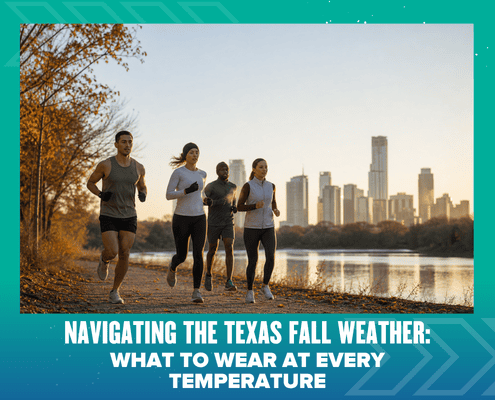
Navigating the Texas Fall Weather: What to Wear at Every Temperature
Ask any Austin runner about fall and you’ll hear the same story: one run starts out sticky and warm, and a few days later a front blows through and you’re digging for gloves you haven’t seen since February. Texas doesn’t do gradual.
That makes knowing what to wear running in fall part of training. Your long runs are getting longer and your group runs are starting earlier, and a bad clothing call on a cool morning can make 16 miles feel like 20. Here’s a simple guide for every kind of morning you’ll get between now and race season.
Quick answer: Dress as if it’s warmer than the thermometer says, because your body heats up fast once you’re moving. Many runners add roughly 15 to 20°F to the actual temperature and dress for that. If you’re comfortable standing still at the start, you’re probably wearing too much.
 Start With the “Dress Warmer” Rule
 Start With the “Dress Warmer” Rule
That 15 to 20°F adjustment is a starting point, not a formula. How you feel matters more than any chart. Lean toward the bigger adjustment for long runs and workouts, when you’ll build more heat. Lean smaller for easy miles, windy mornings, or when you know you run cold.
Runner tip: Keep a quick note in your phone after each run: the temperature, what you wore, and how it felt. In a few weeks you’ll have your own chart, and it’ll beat anything on the internet.
What to Wear Running at Every Temperature
Use this as a starting point and adjust for sun, wind, and humidity:
Humidity is the wild card in Texas. A muggy 60°F morning can feel warmer than a dry 65°F one, so check the “feels like” reading, not just the number.
Layering for Distance Runners: Keep It Simple
 Layering for Distance Runners: Keep It Simple
You don’t need three layers for most Texas fall runs. Here’s how layering for distance runners usually works:
Base layer: This sits against your skin and moves sweat away. Choose synthetic fabric or merino wool. Skip cotton, which holds sweat and stays wet.
Mid layer: A thermal long sleeve or light half-zip for the coldest mornings.
Outer layer: A wind vest or packable shell that blocks the wind without trapping heat.
On most mornings, a base layer plus one removable piece is plenty.
Runner tip: Pick pieces you can take off and carry. Arm sleeves, light gloves, and headbands tuck into a waistband or pocket. A full jacket doesn’t.
When a Cold Front Shows Up Mid-Run
 When a Cold Front Shows Up Mid-Run
This is the true Texas test: you head out in a T-shirt and finish into a north wind. A few ways to stay ahead of it:
Check the hourly forecast. A daily high won’t warn you about a front. The hourly view will.
Run loops. A route that passes your car or a run group’s meeting spot lets you add or drop layers as the morning changes.
Bring a throwaway layer. An old long sleeve you’re fine leaving behind keeps you warm for the first few miles.
Runner tip: Wind changes everything. When a front comes through, dress a little warmer than the temperature alone suggests, especially for the miles running straight into it.
Cold Weather Running Gear Worth Having
 Cold Weather Running Gear Worth Having
You don’t need a new wardrobe to get through Austin’s cooler months. A few pieces of cold weather running gear cover almost every fall morning:
- Lightweight running gloves: Easy to pull off and stash when your hands warm up.
- A moisture-wicking long sleeve: Bright colors help on darker mornings.
- A wind vest: Keeps your core warm without overheating.
- Tights or capris: For the colder runs, if bare legs aren’t your thing.
- An ear-cover headband: Small, packable, and surprisingly useful.
- Reflective or lighted gear: Shorter days mean more miles in the dark.
If you’re not sure what’s still race-ready, our gear checklist post walks through what to inspect and replace.
Test Your Race-Day Outfit During Training
Fall is the time to practice. Pick a few long runs and wear exactly what you plan to wear on race morning, from socks to hat. Chafing, a pocket that won’t hold your gels, or a shirt that rides up are all much better discovered in October than at mile 18.
Runner tip: Pack two race-day options, one for a cooler morning and one for a warmer one, and make sure you’ve tested both.
Fall Training Is Better Together
Cooler mornings are the best time to get back into a routine, whether you’re training for your first full or returning to the start line for another one. Find a local run group, compare notes on what everyone’s wearing, and enjoy the stretch of the year when Austin finally lets you breathe.
FAQ: What to Wear Running in Fall
What should I wear running in fall weather?
Dress as if it’s warmer than the actual temperature, because your body heats up quickly once you’re moving. Start with moisture-wicking fabrics, then add removable layers like gloves, arm sleeves, or a vest as mornings get cooler.
What should I wear for a 50-degree run?
Many runners are comfortable in a short- or long-sleeve tech shirt and shorts at 50°F. Add light gloves if your hands tend to get cold.
Is it better to feel cold or warm at the start of a run?
Slightly cool. You’ll usually warm up within the first mile or so, and starting overdressed can leave you overheated later.
Why shouldn’t I wear cotton when running?
Cotton absorbs sweat and stays wet, which can leave you uncomfortable and chilled on cool, windy mornings. Synthetic and merino fabrics are better choices.
How do I dress for a Texas cold front during a run?
Check the hourly forecast before you head out, wear layers you can remove and carry, and plan a loop route so you can grab or drop layers as conditions change.
When should I switch to running tights?
It’s personal preference. Some runners switch once it gets chilly, while others stay in shorts well into cold weather. Go by how your legs feel and whether wind is a factor.


