The resistance from booty bands can make you a stronger runner
Booty bands: funny name, legit benefits. Running by itself is great. But if that’s all you do you might experience burnout or have an overuse injury. That’s why we’re always talking about cross-training! The benefits runners can see from cycling, swimming, and yoga are endless. Now you can add booty bands to the list! They’re inexpensive, lightweight, and you can work out with them anywhere. We breakdown what they are, talk about their benefits, and provide some of our favorite workouts. They’re especially helpful for first-time runners!
Booty bands explained
Booty bands are small loop bands that can be made from different materials including rubber, cloth, and elastic. These bands usually come in sets with different weights and resistance. They can add additional resistance to natural movements like squats, lunges, slides, and kicks. While they are great for targeting your core and lower body, they can also be used for shoulders and arms. Also known as resistance bands, mini bands, butt bands, and hip bands. They’re a great compliment to your training, especially when you’re increasing your mileage.
Do they work?
Heck yeah they do! Once you work out with them you might realize that you’ve been slacking on working out certain muscles. Because of the added resistance, you will use more stabilizing muscles and feel the burn. They’re one of the simplest additions to your training/workout routine. They’re also great for preventing painful injuries like shin splints. Pro tip: add these endurance circuit workouts to your training too!
Benefits
Inexpensive
Easy to use
Durable
Lightweight and easy to pack/store
Adds a variety to workouts
Great for different levels of fitness
How to use them
Search booty band workouts on Google. You’ll discover so many options that you could literally do a new one each day. That is how versatile they can be. Here are some that caught our eye and that we added to our own workout lineup:
As you can see, we still take cross-training seriously. If we don’t have time to rock climb or ride our bike, we bust out our booty bands. There are times where we even add them to our warm-up routine. Do you already use booty bands and have a favorite workout? Let us know in the Austin Marathon Facebook Group or on Twitter!
https://youraustinmarathon.com/wp-content/uploads/2020/09/Austin-Marathon-2020-Booty-Bands-blog_495x400_092320.jpg400495Austin Marathonhttps://youraustinmarathon.com/wp-content/uploads/2018/11/RBG-color-website-header-340x156website.pngAustin Marathon2020-09-28 05:31:402020-09-28 09:12:26Booty Bands: 4 Reasons Why You’ll Love Their Benefits
Know the 6 factors that may impact your marathon finish time
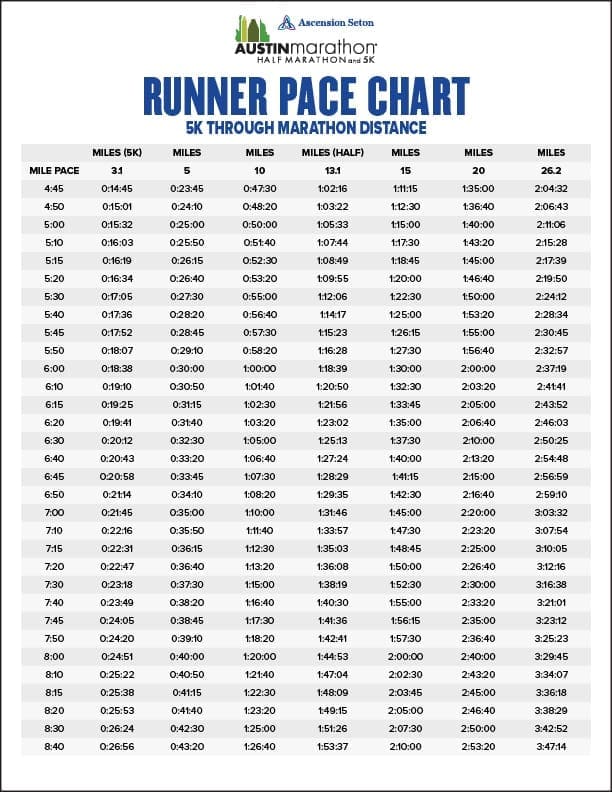
A marathon is 26.2 miles (42.2K) long. While most elite runners can finish a marathon in the 2-hour range, age group runner’s finish times vary greatly. We review the average finish times for different ages below. Runners usually have 8 hours to complete the designated 26.2-mile distance. There are several factors that can influence how long it can take you to finish a marathon. If you already know your running pace, use this helpful pace chart to help predict your finish time or set a new goal!
Training and pace
Like every competition, preparation is critical for a marathon. The amount of training you put in every day before the race is crucial to how your body acclimatizes itself to running long distances. You can roughly calculate how long it could take you to finish a marathon by taking your mile time and comparing it with a marathon pace chart. For example, if you’re completing a mile in 15 minutes then you would likely reach the finish line in about 6.5 hours.
If you don’t know your base pace, you can calculate it. There are tons of different pace calculators available on the internet. Another good way to figure out your base pace is to run a 5K. Your pace in the final mile is a good place to start for predicting your pace. Since you are planning a longer distance you will want to add anywhere from 30 seconds to a minute to calculate your full marathon pace.
Many marathons will have pace groups for certain times to help guide finishers. These pace times can differ from race to race but many times include the required qualifying times for the Boston Marathon. The Austin Marathon is a Boston Marathon Qualifier with hundreds of people getting their BQ each year.
Pace groups available: 2:59, 3:05, 3:10, 3:15, 3:20, 3:25, 3:30, 3:35, 3:40, 3:45, 3:50, 3:55, 4:00, 4:05, 4:20, 4:35, and 4:50
The pace group leaders will run “even splits.” This means that every mile will be run at approximately the same pace
Think of them as a moving finish line with your goal time pinned to the back of their shirts
Age and gender
Although age and gender do not restrict your ability as a runner, there are considerable differences in the stats in these categories. On average, men complete a marathon in a little more than 4 hours, while women take roughly 4.5 hours. The marathon running population is typically 30-40 percent female and60-70 percent male. People of all ages complete a marathon, though the bulk are between 30 and 50 years of age.
Average finish time by gender and age group from the 2020 Austin Marathon
These stats are important to know so that you can plan accordingly and maybe even take home an age group award. Age group awards are usually presented to the top 3 male and female overall in each age group. Categories begin with 19 & under and end with 85+. Groups increase in five-year increments.
Awards for the Austin Marathon (for male and female) include:
Overall champion
2nd place
3rd place
Age Groups: 19 & under 20-24, 25-29, 30-34, 35-39, 40-44, 45-49, 50-54, 55-59, 60-64, 65-69, 70-74, 75-79, 80-85, 85+
Terrain and weather
One part that can affect how long it takes to finish a marathon is the course’s terrain. The flatter the course, the lesser the effort required to run on it. But terrain does not necessarily dictate success or make a course hard or easy. With proper training for a course, you can set a PR (personal record) on all different styles of course. Pro tip: Try and run the course before race day. Practice some of your long runs on the course if you can!
As much as terrain decides the intensity of the challenge, weather can significantly impact how long it will take you to finish a marathon. If it is warmer than normal, your energy could drain faster. Your body consumes more energy to perform the task at hand and keep your body cool. Participants normally prefer the cooler temperatures in the winter months. But as with everything, if it gets too cold this could impact your time because it could take longer to warm up at the start.
Knowing about these factors and how they can impact how long it could take you to finish a marathon will help on race day. Keep a record of your time and work to improve it at your next marathon. With proper training and dedication, you could set a brand new marathon PR! How do you prepare for these factors during your training? Have they impacted how long it took you to finish a marathon? Let us know in the Austin Marathon Facebook Group or on Twitter.
https://youraustinmarathon.com/wp-content/uploads/2020/09/Austin-Marathon-2020-how-long-does-it-take-to-finish-a-marathon_495x400_090320.jpg400495Austin Marathonhttps://youraustinmarathon.com/wp-content/uploads/2018/11/RBG-color-website-header-340x156website.pngAustin Marathon2020-09-07 06:02:232024-06-04 15:21:02How Long Will it Take You to Finish a Marathon?
Improve your running performance when you add cycling to your training
Are you a marathon runner looking to optimize your performance? Have you recently discovered marathons and want to learn more about training? Either way, maximizing your stamina, endurance, and physical fitness is crucial to improving your running performance.
Running is an activity that necessitates the use of leg muscles to a large extent. A complete training program is crucial if you want to improve your running performance. It’s important to exercise and strengthen all muscle groups. Fitness experts recommend that you cross-train. Cycling is a great way to cross-train. Riding your bike at least once a week can help you train smarter and improve your running performance as a marathoner.
Cross-training involves activities other than your usual sport. In the case of marathoners, it involves exercises other than running. You might run fewer miles, but cross-training helps engage more muscle groups, enhance endurance, and strengthen leg muscles.
Why cycling is beneficial
Many runners choose cycling for their cross-training and also follow this advice when increasing their mileage. Here are some benefits runners can take advantage of when they begin cycling:
Prevent overuse of leg muscles
Overuse injuries are very common in long-distance running. Integrating another activity can make all the difference between an overuse injury and making it to the finish line. Using the bike reduces impact on your body, especially your feet, while continuing to strengthen your leg muscles. Pro tip: if something doesn’t feel right, get it checked out! Learn how the Ascension Seton Sports Performance experts can get you back on track and headed to your goal.
Strengthen complementary muscles
While short distance runs or sprints can help build muscles, long-distance running is known to hinder muscle growth. The main muscle groups used in cycling are the upper leg muscles like your quadriceps and hamstrings. However, you also use your calf muscles, gastrocnemius, and soleus. Cycling also engages your core and back while giving your arms and shoulders a good workout. As a form of resistance workout, cycling builds and strengthens these different muscle groups.
Expand lung capacity
True, you’ll log fewer running miles by cycling. But you won’t sacrifice some of running’s benefits, like expanding your lung capacity. Simply put, the more fresh oxygen you take in, the more oxygen can be pumped to your muscles. That’s a good thing! While on the bike, you can also practice breathing patterns. The more you can comfortably control your breathing, the lower you can keep your heart rate. A lowered heart rate can relieve some of the stress your body experiences during training.
Cycling is an ideal addition that can better your aerobic system while being easier on your muscles, joints, and tendons. Riding your bike once or twice can improve your running performance. It’s a great complementary activity that can help you achieve faster running times and reduce the chance injuries. Do you cycle as a means of cross-training? Let us know why in the Austin Marathon Facebook Group or on Twitter.
https://youraustinmarathon.com/wp-content/uploads/2020/08/812176_Austin-Marathon-2020-Cycling-Can-Improve-Your-Running_495x400_feature.png400495Austin Marathonhttps://youraustinmarathon.com/wp-content/uploads/2018/11/RBG-color-website-header-340x156website.pngAustin Marathon2020-08-31 05:20:322020-08-31 08:23:28How Cycling Can Help You Improve Your Running Performance
A personal story of weight loss, finding self love, and running a marathon.
In this story we meet Kiah Twisselman, who you may recognize from her appearances in People Magazine, Women’s Health Magazine, or on Good Morning America. Kiah believed that her goals were impossible, but with some very simple steps, she was able to overcome obstacles and make her wishes come to life.
This goal to make the impossible possible is that mindset that Kiah wishes to share with her story. She wants to teach people the mental tools she has used to create a life of joy from the inside out.
My name is Kiah and I’m a cattle rancher turned entrepreneur and life coach. I was raised on my family’s cattle ranch in rural California. I battled with my weight all through my childhood up to my mid-twenties. My mindset told me there was no way I could have a healthy lifestyle. I played the victim to my obesity for years, blaming my genetics for why I couldn’t lose the weight. My career was my excuse for why I didn’t invest in the gym. There wasn’t enough time and money.
In 2018, I was on a flight for work. For the first time in my life, I had to request a seatbelt extender. It felt like a new low for me. Coincidentally, just before the flight, I purchased “Girl, Wash Your Face” by Rachel Hollis. That book contained the words I needed to read at the exact time I needed to read them. Hollis’ book was my wake-up call. If I wanted to change anything about my life – my career, my health, my lifestyle – then I needed to take ownership of my life. I needed to start making better choices for myself.
[bctt tweet=”I shifted my motivation for my weight loss. I went from a place of self-hate and desperation to a place of choosing to be one percent better each day because I LOVED myself enough to show up and do the hard work.” username=””]
5 Simple Steps to a Healthier Lifestyle
Later that year, October 1, 2018, I started my health journey (again) with five simple habits as part of Hollis’ Last 90 Days Challenge.
Wake up one hour earlier for yourself
Give up one food that doesn’t bless your body
Drink half your body weight in ounces of water
Write down 10 things you’re grateful for
Move your body for at least 30 minutes a day
After 90 days I lost 25 pounds. For the first time in my life, I didn’t feel like I was making empty promises to myself every New Year. More importantly than the habits, I had really started to work on my mindset.
In one year, without any fad diets or a gym membership, I lost 103 pounds. What had seemed impossible was possible. To date, I have lost more than 125 pounds.
Earlier this year I had the incredible honor of being featured in People Magazine, Good Morning America, Access Hollywood, and Women’s Health for my weight loss transformation. Now I’m a full-time life coach and weight loss coach. My mission is to empower others around the world to love themselves through health and happiness, too.
[bctt tweet=”I want to teach people the mental tools I learned that helped me create a life of joy from the inside out. ” username=””]
My journey is far from over. I continuously challenge my own beliefs about what is possible. Running used to be my least favorite activity of all time. Yet here I am training for the 30th annual Ascension Seton Austin Marathon, my very first marathon! Amazing things can happen when we start believing in ourselves. I look forward to seeing you on-course and at the finish line in February 2021!
Kiah’s bright personality and real love for life shine through in everything she does. We know that she will absolutely crush her goal of becoming a marathon finisher. Be sure to her journey and connect with her on Facebook and Instagram.
Remember, you too can make the impossible possible, just believe in yourself. Looking for a supportive community? Join our Facebook Group and follow our blog for our latest advice and more inspirational stories.
https://youraustinmarathon.com/wp-content/uploads/2020/08/Austin-Marathon-2020-Kiahs-story_940x788_082620.png788940Austin Marathonhttps://youraustinmarathon.com/wp-content/uploads/2018/11/RBG-color-website-header-340x156website.pngAustin Marathon2020-08-28 10:06:492020-09-16 10:51:32Inspiring Story about How to Make the Impossible Possible
