• Link to Facebook
  • Link to X
  • Link to Instagram
  • Link to Mail
  • Link to Vimeo
  • Contact Us
  • Newsletter
  • Marathon Results and Tracking
#RunAustin
Austin Marathon
  • Event Details
    • About
      • About Us
        • Contact
        • Media Inquiries
          • Photography & Media Requests
      • Abbott World Marathon Major
        • How to Qualify for the AbbottWMM Age Group World Championships
    • Participant Info
      • FloTrack Live Coverage
      • Finisher Medal
      • Race Weekend Schedule
      • Divisions & Awards
      • Athlete Tracking & Results
      • Hotels
      • 5K Run
      • Mobile App
      • Official Race Photos
      • Finish Line Festival
      • Entertainment on Course
      • Rules & Violation Policy
      • FAQ
      • Shop
    • Packet Pick Up
      • Hours & Location
      • What’s In My Packet?
      • Explore the Expo
      • Parking
    • Teams & Charity
      • Team Registration
        • Team Perks & Deadlines
        • Team Leaderboard
        • Team Management
      • Charity
        • About Austin Marathon Gives
        • Run For Charity
        • Run Forward Initiative
    • Volunteer
      • About Volunteering & FAQ
      • Volunteer Registration
      • Returning Account Login
  • Course
    • Watch 2025 Coverage
    • Start Waves
    • Course Maps
    • Course & Amenities
    • Traffic Guide
    • Race Morning Parking
    • Spectating at the Austin Marathon
  • Blog
  • Heart Health
  • Sponsorship
    • Sponsors
    • Become a Sponsor
    • Become an Exhibitor
  • Register Now
    • Special Programs
      • Military Appreciation Year
      • Run For Charity
      • Run Forward Initiative
      • Gift Registration
      • Elite Athlete Program
      • RUN AUSTIN
        • Running Groups
    • Registration Details
      • Rules & Violation Policy
      • Flexible Payment with Affirm
      • Register On Mobile
      • Pricing
      • Registration Change Policy
      • Check Your Registration
  • Menu Menu

Tag Archive for: Austin Marathon training

Building Your Summer Base: The Right Way to Add Mileage

in Blog post

Summer is where strong marathon seasons are made. It is also where runners most often get hurt by adding too much, too fast. If you are training toward the Austin Marathon, your goal for the summer is simple: build a durable aerobic base that sets you up for confident marathon-specific workouts later.

This guide walks you through how to add mileage the right way, so you can stack consistent weeks, stay healthy, and show up in the fall ready to train.

What “base building” really means

Base building is a phase of training focused on:

  • Consistency over intensity
  • Easy aerobic running as the foundation
  • Gradually improving tendon, muscle, and bone durability
  • Building the habit of recovery, fueling, and sleep that marathon training requires

You do not need to run fast all summer. You need to run smart, frequently, and within your current capacity.

The biggest mistake: chasing mileage instead of consistency

Many runners think base building is about hitting a specific weekly number. In reality, the best base comes from stringing together weeks you can repeat.

A great weekly mileage target is one that you could complete again next week without feeling wrecked.

Ask yourself after each week:

  • Did I finish the week feeling like I could do it again?
  • Did any niggles show up (feet, Achilles, knees, hips)?
  • Did I sleep well and recover between runs?

If the answer is “no,” your mileage is too aggressive, even if it looks fine on paper.

A simple rule for adding mileage safely

1) Increase gradually (and not every week)

A reliable approach is:

  • Increase weekly mileage by 5 to 10 percent when things feel good
  • Every 3rd or 4th week, take a cutback week (reduce volume by 10 to 25 percent)

Cutback weeks are not failures. They are how your body absorbs the work so you can keep progressing.

2) One “new stress” at a time

Mileage is a stress, and so are heat, hills, speed, and strength training. If you increase multiple stresses at once, injury risk rises quickly.

If you add mileage this week, keep these stable:

  • pace (keep most runs easy)
  • hills
  • workout intensity
  • strength training volume

What your weekly structure should look like

A sustainable base week usually includes:

  • 3 to 6 runs per week depending on experience
  • Most miles easy (conversational pace)
  • One long run
  • Optional: 1 light workout (like strides or a short tempo) only if you are handling the load well

The “80 to 90 percent easy” rule

For base building, aim for:

  • 80 to 90 percent of your running at an easy effort
  • 10 to 20 percent at moderate or faster efforts (if any)

Easy running builds aerobic capacity and durability with lower injury risk. It is the safest way to increase volume.

How to progress your long run (without overdoing it)

Your long run should support the week, not destroy it.

General guidelines:

  • Long run is often 20 to 30 percent of weekly mileage
  • Increase long-run distance slowly, especially if you are also increasing total weekly miles

A practical method:

  • Add 1 to 2 miles to the long run every 1 to 2 weeks
  • Use cutback weeks to shorten the long run as well

If you finish the long run so depleted that the next two days are compromised, your long run is too long for your current base.

Summer running in Austin: heat changes everything

Training through Texas summer heat adds stress, even at easy paces. If you try to keep pace goals from cooler months, you may accidentally turn easy runs into hard runs.

Heat-smart strategies

  • Run early, or choose shaded routes
  • Use effort, not pace, to guide easy runs
  • Hydrate before and after, and consider electrolytes for longer runs
  • Wear breathable clothing and light colors
  • Shorten runs when heat and humidity spike

Important: In hot conditions, it is normal for pace to slow. You are still building your base if the effort stays easy.

Strength training: the injury-prevention accelerator

Adding mileage works best when your body is strong enough to handle it.

Aim for 2 short sessions per week focused on:

  • glutes and hips (bridges, deadlifts, step-ups)
  • calves and Achilles (calf raises, eccentric heel drops)
  • core stability (planks, side planks, carries)
  • single-leg balance (lunges, split squats)

Keep strength training consistent but not exhausting. You should leave the gym feeling better, not wiped out.

The warning signs you are adding too much, too soon

Pay attention to:

  • soreness that does not improve after an easy day
  • pain that changes your stride
  • tightness that shows up at the same mile marker each run
  • sudden drop in motivation or sleep quality
  • elevated resting heart rate, unusual fatigue

If you notice these, pull back early. One small adjustment can prevent a multi-week setback.

A sample 4-week summer base progression (example)

This is a template. Adjust the numbers to match your current level.

Week 1 (baseline): Hold steady mileage, establish routine

Week 2 (build): +5 to 10 percent total miles

Week 3 (build): +5 to 8 percent total miles, or hold steady if heat is high

Week 4 (cutback): -10 to 25 percent total miles, keep frequency if possible

Repeat the cycle.

The goal by the end of summer

For Austin Marathon runners, a successful summer base means:

  • you can run most days (if desired) without breaking down
  • your long run feels controlled and repeatable
  • your easy pace effort stays easy, even in the heat
  • you are healthy, consistent, and ready for marathon-specific training

Consistency is the win. Everything else builds from that.


FAQ: Building a running base and adding mileage

How many miles should I run per week for a marathon base?

It depends on your history. A strong base is the highest weekly mileage you can repeat consistently while staying healthy. Many runners do well building into a steady range first, then increasing later with structured training.

Should I do speed work during base building?

Keep it minimal. Strides (short, relaxed accelerations) once or twice per week can help maintain leg turnover. Save heavy workouts for later phases.

Is the 10 percent rule always safe?

It is a guideline, not a guarantee. In summer heat or after time off, 10 percent can still be too much. When in doubt, increase less, or add mileage every other week.

What if I miss a week?

Resume at a conservative level. Do not try to “make up” mileage. Your body responds to consistent training, not repayment plans.

https://youraustinmarathon.com/wp-content/uploads/2026/05/Building-Your-Summer-Base-The-Right-Way-to-Add-Mileage-Austin-Marathon-1.png 400 495 Gero https://youraustinmarathon.com/wp-content/uploads/2018/11/RBG-color-website-header-340x156website.png Gero2026-05-29 13:53:052026-05-29 13:53:05Building Your Summer Base: The Right Way to Add Mileage

Earn Your Ticket to the AbbottWMM Wanda Age Group Championship at the Austin Marathon

in Blog post

2024 Austin Marathon participants can earn a spot at AbbottWMM Wanda Age Group Championships

Mark your calendars for February 18, 2024, because Austin, Texas, is where the action’s at. The Ascension Seton Austin Marathon is your passport to an adrenaline-fueled adventure as it returns as one of the selected qualifying marathons for the Abbott World Marathon Majors Wanda Age Group World Rankings. The AbbottWMM Wanda Age Group World Rankings comprise over 375 qualifying races in over 90 different countries in which athletes in nine separate age groups can compete in marathons across the world to earn a global ranking. 

Compete against runners from around the world

The spread of the AbbottWMM Wanda Age Group Qualifying Events creates a truly global series throughout the year. This gives runners across the world the chance to be part of a new era of age-group marathon running. 

The 2024 season will be the 6th edition of the rankings, with runners competing to earn an invitation to the 2025 AbbottWMM Wanda Age Group World Championships.

Dawna Stone, Abbott World Marathon Majors CEO said: “The Abbott World Marathon Majors Wanda Age Group World Rankings continue to grow and welcome new races into the qualifying process every year. The geographical spread of runners and races shows the appetite for high level competition across all ages and an invite to the World Championships is becoming a much sought-after goal.” 

How it Works

Athletes will be ranked according to their single fastest time in a qualifying event. Any athlete achieving the Automatic Qualifying Time for their age group will receive an immediate invitation for the 2025 AbbottWMM Wanda Age Group World Championships.

Highly-ranked runners who do not achieve the Automatic Qualifying Time still have the opportunity to receive an invitation to enter the World Championship depending on the full field size and the number of athletes achieving the qualifying time.

In order to receive an invitation, runners must be registered at AbbottWMM.com. The date, location, and field size for the 2025 AbbottWMM Wanda Age Group World Championships will be announced in due course.

Age Group Qualifying Times 

Times are subject to final confirmation by AbbotWMM at the end of 2023.

 2024 Qualifying times Age Group 

Male 

Female 

40-44 

02:35 

03:05 

45-49 

02:42 

03:11 

50-54 

02:48 

03:21 

55-59 

02:57 

03:30 

60-64 

03:10 

03:48 

65-69 

03:26 

04:06 

70-74 

03:40 

04:35 

75-79 

04:06 

05:05 

80+ 

04:40 

05:25 

Qualifying for the 2025 AbbottWMM Age Group Championship

There are three ways to qualify for the championships.

1. Achieve the Automatic Qualifying Time for your age group

2. Other highly ranked athletes without an Automatic Qualifying Time may also receive an invitation, depending on the full field size and the number of athletes achieving the qualifying time.

3. The bi-annual AbbottWMM Global Marathon, held within the Global Run Club, has 200 places available for the fastest verified finishers. Visit the Global Run Club for full details.

Full details here.

So, as the Austin Marathon countdown begins, imagine the cheers of the crowd, the beat of your heart, and the thrill of knowing that you could earn a spot at the 2025 AbbottWMM Wanda Age Group World Championships. It’s not just a marathon; it’s a global celebration of running . The path to championship glory is paved with determination and a dash of fun. The Austin Marathon beckons and the world is your playground – get ready to run, laugh, and make memories that will last a lifetime. It’s marathon time, and the adventure begins here!

https://youraustinmarathon.com/wp-content/uploads/2020/07/788439_Austin-Marathon-2020-Abbott-World-Qualifier-2022_495x400_2B_073120.jpg 400 495 Austin Marathon https://youraustinmarathon.com/wp-content/uploads/2018/11/RBG-color-website-header-340x156website.png Austin Marathon2023-10-18 13:40:362023-10-18 15:28:00Earn Your Ticket to the AbbottWMM Wanda Age Group Championship at the Austin Marathon

How to Prevent Running Injuries: A Guide for the Austin Marathon

in Blog post, Training Advice

Running is a fantastic way to challenge yourself, stay fit, and push your limits, but it’s equally important to take care of your body to avoid injuries that could sideline your marathon goals. In this comprehensive guide, we’ll explore key strategies and tips to help you stay injury-free as you prepare for the Austin Marathon.

Read more
https://youraustinmarathon.com/wp-content/uploads/2023/07/How-to-Prevent-Running-Injuries_-A-Guide-for-the-Austin-Marathon.png 400 495 Gero https://youraustinmarathon.com/wp-content/uploads/2018/11/RBG-color-website-header-340x156website.png Gero2023-08-14 12:58:072023-10-12 13:34:31How to Prevent Running Injuries: A Guide for the Austin Marathon

How Long Will it Take You to Finish a Marathon?

in Blog post

Know the 6 factors that may impact your marathon finish time

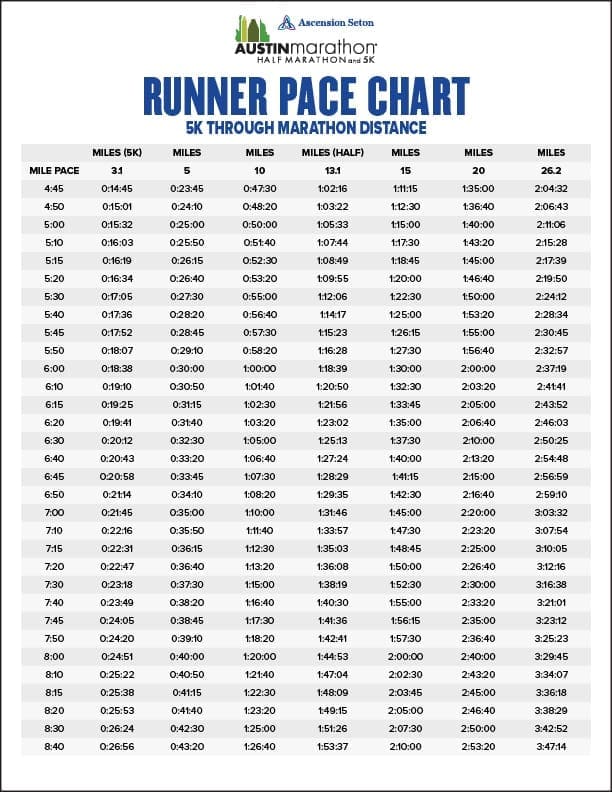
A marathon is 26.2 miles (42.2K) long. While most elite runners can finish a marathon in the 2-hour range, age group runner’s finish times vary greatly. We review the average finish times for different ages below. Runners usually have 8 hours to complete the designated 26.2-mile distance.  There are several factors that can influence how long it can take you to finish a marathon. If you already know your running pace, use this helpful pace chart to help predict your finish time or set a new goal!

Training and pace

Runner Pace Chart for 5K Half Marathon and marathon finish time predictionLike every competition, preparation is critical for a marathon. The amount of training you put in every day before the race is crucial to how your body acclimatizes itself to running long distances. You can roughly calculate how long it could take you to finish a marathon by taking your mile time and comparing it with a marathon pace chart. For example, if you’re completing a mile in 15 minutes then you would likely reach the finish line in about 6.5 hours.

If you don’t know your base pace, you can calculate it. There are tons of different pace calculators available on the internet. Another good way to figure out your base pace is to run a 5K. Your pace in the final mile is a good place to start for predicting your pace. Since you are planning a longer distance you will want to add anywhere from 30 seconds to a minute to calculate your full marathon pace.

Many marathons will have pace groups for certain times to help guide finishers. These pace times can differ from race to race but many times include the required qualifying times for the Boston Marathon. The Austin Marathon is a Boston Marathon Qualifier with hundreds of people getting their BQ each year. 

  • Pace groups available: 2:59, 3:05, 3:10, 3:15, 3:20, 3:25, 3:30, 3:35, 3:40, 3:45, 3:50, 3:55, 4:00, 4:05, 4:20, 4:35, and 4:50
  • The pace group leaders will run “even splits.” This means that every mile will be run at approximately the same pace
  • Think of them as a moving finish line with your goal time pinned to the back of their shirts

Age and gender

Although age and gender do not restrict your ability as a runner, there are considerable differences in the stats in these categories. On average, men complete a marathon in a little more than 4 hours, while women take roughly 4.5 hours. The marathon running population is typically 30-40 percent female and 60-70 percent male. People of all ages complete a marathon, though the bulk are between 30 and 50 years of age. 

Average finish time by gender and age group from the 2020 Austin Marathon

Average Finisher Times based on age group for the austin marathon

These stats are important to know so that you can plan accordingly and maybe even take home an age group award. Age group awards are usually presented to the top 3 male and female overall in each age group. Categories begin with 19 & under and end with 85+. Groups increase in five-year increments.

Awards for the Austin Marathon (for male and female) include:

  • Overall champion
  • 2nd place
  • 3rd place
  • Age Groups: 19 & under 20-24, 25-29, 30-34, 35-39, 40-44, 45-49, 50-54, 55-59, 60-64, 65-69, 70-74, 75-79, 80-85, 85+

Terrain and weather

One part that can affect how long it takes to finish a marathon is the course’s terrain. The flatter the course, the lesser the effort required to run on it. But terrain does not necessarily dictate success or make a course hard or easy. With proper training for a course, you can set a PR (personal record) on all different styles of course. Pro tip: Try and run the course before race day. Practice some of your long runs on the course if you can!

As much as terrain decides the intensity of the challenge, weather can significantly impact how long it will take you to finish a marathon. If it is warmer than normal, your energy could drain faster. Your body consumes more energy to perform the task at hand and keep your body cool. Participants normally prefer the cooler temperatures in the winter months. But as with everything, if it gets too cold this could impact your time because it could take longer to warm up at the start.

Knowing about these factors and how they can impact how long it could take you to finish a marathon will help on race day. Keep a record of your time and work to improve it at your next marathon. With proper training and dedication, you could set a brand new marathon PR! How do you prepare for these factors during your training? Have they impacted how long it took you to finish a marathon? Let us know in the Austin Marathon Facebook Group or on Twitter.

https://youraustinmarathon.com/wp-content/uploads/2020/09/Austin-Marathon-2020-how-long-does-it-take-to-finish-a-marathon_495x400_090320.jpg 400 495 Austin Marathon https://youraustinmarathon.com/wp-content/uploads/2018/11/RBG-color-website-header-340x156website.png Austin Marathon2020-09-07 06:02:232024-06-04 15:21:02How Long Will it Take You to Finish a Marathon?
Page 1 of 41234

Signup for Newsletter

Search Search
Recent
  • Two runners in red shirts giving thumbs-up
    Nutrition Basics for Long-Distance RunnersJune 12, 2026 - 7:00 AM
  • Ascension Seton Austin Marathon Opens Exhibitor Registration...June 11, 2026 - 7:00 AM
  • Run as a Team, Pay as an Organization: Bulk Pay for the...June 10, 2026 - 8:46 AM
  • Runner leading group during uphill road race
    Hill Training Tips for Conquering Austin’s CourseJune 8, 2026 - 7:00 AM

High Five Events (owners of Austin Marathon) is a participant in the Amazon Services LLC Associates Program, an affiliate advertising program designed to provide a means for sites to earn advertising fees by advertising and linking to amazon.com at no additional cost to the user.

Stay Up to Date

Latest Posts

  • Two runners in red shirts giving thumbs-up
    Nutrition Basics for Long-Distance Runners
  • Ascension Seton Austin Marathon Opens Exhibitor Registration for 2027 Health & Fitness Expo
  • Run as a Team, Pay as an Organization: Bulk Pay for the Austin Marathon

Search

  • Contact Us
  • Sponsors
  • Volunteer
  • Media
  • Privacy
  • USATF Safe Sport Handbook

Search

Search Search
© Copyright - Austin Marathon and Half Marathon
  • Link to Facebook
  • Link to X
  • Link to Instagram
  • Link to Mail
  • Link to Vimeo
  • Contact Us
  • Sponsors
  • Volunteer
  • Media
  • Privacy
  • USATF Safe Sport Handbook
Scroll to top Scroll to top Scroll to top